 |
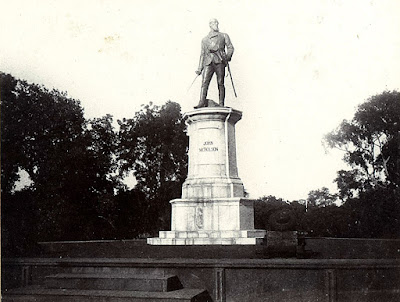
| John Nicholson's statue in Delhi, in 1911 |
On Sep 13, 1958*, a large wooden crate arrived in Dungannon, a town in Northern Ireland. Inside it was a 10-foot-tall, 2-tonne bronze statue that had stood in Delhi for 51 years. John Nicholson, who lives in the village of Loughgall, 17km outside the town, was a student at Royal School Dungannon (RSD) at the time. He remembers the crate lay in the school grounds “for a couple of years before the statue was erected”.
For weeks, the people of Dungannon didn’t know the statue was of RSD’s most famous pupil, Brigadier General John Nicholson who also happened to be young John Nicholson’s distant ancestor. “We belong to the same family of Nicholsons that the General was descended from,” says John, who’s touching 80.
The statue had been moved out of Delhi under a veil of secrecy, but in the half-century it spent on a pedestal outside Kashmere Gate, it had been a ‘protected monument’, like Taj Mahal and Ellora Caves. Travel Guides like ‘Delhi in Two Days’ recommended it to visitors.
Now placed 7,000km away as the crow flies, the statue in the crate was still on India’s list of protected monuments. Surely, someone in the culture ministry would have noticed the mistake and struck it off the list in the weeks afterwards?
No, 66 years have gone by but ‘Nicholson statue and its platform and the surrounding garden paths and enclosure wall’ are item 358 on Archaeological Survey of India’s list. Nicholson Garden, where the statue stood, has been renamed Maharaja Agrasen Park and a statue of the Maharaja presides over it, but someone has updated the missing Nicholson statue’s address to ‘Kashmere Gate, near Metro station’. Which is very odd because the metro came to Delhi only 20 years ago.
Nicholson, Alias Nikal Seyn
Gen Nicholson’s statue was installed and then removed from Delhi for the same reason: he was a British colonial hero who saved the Raj in its biggest crisis. A 6’2” tall, bearded administrator and soldier, he orchestrated the British recapture of Delhi in 1857. As soon as Kashmere Gate blew up on Sep 14, 1857, he led his troops into the city through the breach and was shot in street fighting.
On the Indian side, he was understandably less popular, and these days even White writers have started calling him ‘sadistic’. William Dalrymple labelled him “great imperial psychopath” in The White Mughal. Modern historians are especially horrified by Nicholson’s decision to hang his regimental cooks, without trial, for poisoning the officers’ soup on the march to Delhi in 1857.
Yet, Nicholson’s gruff reputation had won him many local admirers in the newly annexed Punjab while he lived. Some even worshipped him as Nikal Seyn, a god, and called themselves Nikalsenis. Kipling mentions them in Kim: “wail by long-drawn wail he unfolded the story of Nikal Seyn – the song that men sing in the Punjab to this day”.
Almost 50-Year Wait For Statue
When Kipling wrote Kim in 1901, there was no Nicholson statue in Delhi. Some of the veterans of 1857 had been thinking about installing one, and in 1902 Viceroy Lord Curzon allowed them to set up a fund for it.
The Daily Sun, an American newspaper, reported on Sep 6, 1902: “A fund has been started in England for the purpose of erecting a monument to one of the great heroes of the Indian mutiny… It is now proposed that a bronze statue of Nicholson shall be erected in the Nicholson Garden at Delhi.”
When the contributions added up to Rs 47,000, London’s famous sculptor Thomas Brock was commissioned to make the statue. Brock is known for his Queen Victoria Memorial outside Buckingham Palace, and the Victoria statue inside Kolkata’s Victoria Memorial. As he had no portrait from Nicholson’s final years, he relied on a marble bust that had been sculpted soon after Nicholson’s death on Sep 23, 1857.
The Builder magazine of June 18, 1904 assessed the statue’s plaster cast: “Nicholson is represented as holding his sword in one hand and the sheath with the other; the head is fine but perhaps rather too gentle in expression for one who was such a determined fighter…” Brock was able to recreate the General’s khaki coat and sword more realistically as the originals had been preserved by a Mr J Angelo and Lord Magheramorne, respectively.
The statue was finally inaugurated opposite Kashmere Gate on Friday, April 6, 1906, “at the spot where Nicholson had stood on Sept 14, 1857,” waiting for a bugle call that would have signalled the gate had been blown in.
At the unveiling ceremony, Viceroy Lord Minto said, “British and Indian troops stand here together as they have stood side by side on many a hard-fought field to do honour to the memory not only of a British officer of the Indian Army, the John Nicholson of his British comrades, but to the memory of the beloved and worshipped Nikal Seyn Sahib, the revered leader of Pathan and Punjabi warriors.”
This event was reported far and wide. “The unveiling of an heroic statue of John Nicholson before the Cashmere Gate of Delhi is a worthy, though belated, tribute to one of the world’s most gallant soldiers and to one of the greatest figures of the Mutiny,” New York Daily Tribune of April 20, 1906 wrote.
A year later, in December 1907, a ‘miscreant’ snuck up to the statue and defaced it.
Time To Pack Up And Leave
Despite occasional displays of local animus, the Nicholson statue stood relatively unmolested in Delhi for the next 50 years. Chester Bowles, US ambassador to India during 1951-53 remarked in his memoir that while newly independent Indonesians were busy toppling Dutch colonial statues, Indians were cool with British statues and streets named after viceroys and generals.
“I have never heard an Indian suggest that they (the names of streets) be changed… Even a statue of Nicholson, who led the British against Indians during the ‘Mutiny’, still stands, sword in hand,” Bowles wrote.
But the mood in India was already changing. As the centenary of the 1857 Uprising neared, a clamour arose for removing all British statues. Nicholson’s statue was at the top of the hit list, and word reached Ireland through Mrs Edith Wilson, a missionary in India. Her nephew, Major TCH Dickson, was on the board of RSD, where Nicholson had studied from 1834 to 1838. So the school’s old boys started a campaign to rescue the statue.
From Pedestal To Crate
The centenary of the Uprising started on May 10, 1957, and Nicholson’s statue was the first to be toppled in Delhi, followed by that of his comrade Alexander Taylor near Mori Gate in the first week of June. Six months later, they were still “lying crated in the exhibition grounds here, pending a decision on their fate,” Reuters reported in December.
Meanwhile, backroom negotiations were on to get them out. A 1998 article in Chowkidar, magazine of British Association for Cemeteries in South Asia (BACSA), says permission to transfer the Nicholson statue was obtained through the Foreign and Commonwealth Office, “and it left Delhi on 17 July 1958”. A housing ministry note of July 16, 1958 confirms that Central Public Works Department had moved the statue to the British High Commission “only recently”.
Old Boy Comes Home
The crate reached Dungannon in September but the press didn’t know about it for almost a month, until “pupils got hold of the secret and soon the whole town knew about it”. Glasgow Herald wrote about it on Oct 8. Belfast Telegraph did a bigger report, saying the statue “had been rescued from certain destruction”.
As RSD was being expanded at the time, the statue lay in its crate for two more years before it was installed on a pedestal and unveiled by India’s last viceroy, Lord Mountbatten, on April 13, 1960.
John Nicholson of Loughgall village was present in the grounds along with some 200 other people that day. “The inauguration ceremony seemed to be a rather reserved and low-key event, probably for security reasons, I suspect,” he told TOI. “None of the other pupils were involved in any form of celebration. I think that at the time there was little awareness of the historical significance of the whole event.”
A few years after John left RSD, the school added a fourth house: Nicholson House. Ivor Edgar, who taught history at the school 1969 onwards, says Nicholson House was added in 1967: “I am not sure if there was a campaign to commemorate Nicholson in this way, or whether growing school numbers necessitated the addition of a fourth house, and Nicholson was seen as a suitable name, but I suspect the latter version to be the more likely.”
But Nicholson didn’t become a topic of discussion or teaching at the school. “Nicholson never featured on the history syllabus. Nor, I imagine, is he much remembered, let alone commemorated, in the town, except as another distinguished Old Boy and soldier,” says Edgar.
Prof Noel Purdy, RSD pupil from 1983 to 1990 and director of research & scholarship at Belfast’s Stranmillis University College now, says, “There was little or no mention of Nicholson and his career in India” at school. “I walked past the statue every day for seven days, on my way in and out of school. It is right in front of the headmaster’s house (and out of bounds for playing).”
Edgar, who was Purdy’s history teacher, agrees: “The Dungannon statue’s main use in recent years is as a picturesque backdrop for photographs, set as it is among sweet chestnut trees.”
But Purdy thinks it’s a mistake for the school to brush Nicholson’s “distinguished military career in India” under the carpet. “While his career would undoubtedly be judged very differently by today’s standards, nonetheless I believe that there is enormous potential in using his story as a stimulus for discussion and debate among today’s pupils,” he says.
Edgar recalls that even before he joined RSD as a teacher, pupils had started treating Nicholson’s statue with some irreverence: “I learned that it had become something of an annual tradition to festoon Nicholson in an RSD scarf and a silly hat, or something similar. This took place, probably, on the last day of the school year or some other significant date. On occasion, the sword was removed as well. It was always returned though.”
The sword, yes, what became of it? In all recent photos, the General is bereft of it. Edgar says, “I am glad to report that it is safe and well, and securely locked away. In this day and age the school, fearful of losing the sword altogether, and given the ease with which it can be removed, decided to keep it safe from future pranks. I am sure that, if the occasion demanded, it could be replaced on a temporary basis.”
In 1998, the then RSD headmaster, PD Hewitt, had also told BACSA: “Nicholson’s ceremonial sword has occasionally been stolen, so is now only put up for major school events.”Will It Stay At RSD?
John, his wife Jane, and some cousins visited Delhi in 2007 to commemorate the General’s 150th death anniversary. John told TOI: “We visited his tomb in the British graveyard (Nicholson Cemetery) which had all been beautifully restored and cared for by the Indian authorities. It was a very special and historic visit for us.”
But while India has put the statue and its controversy behind, Jane, who helped in writing this article by sharing old news clippings from her mother-in-law’s scrapbook, seemed concerned about its future at RSD. While it has a high heritage status (B+) in Northern Island, in an age of revisionist histories, how secure is it on its pedestal?
“We’re waiting for the day when the statue is removed. A sad state of affairs…” Jane let slip in one email, but quickly added: “Please don’t be alarmed! We have had absolutely no inkling of any impending removal.” Nonetheless, her concern stems from “liberals in the UK who have been tearing down/removing statues/renaming schoolhouses”.
Well, it isn’t a good time to be an icon from the past. Forget Clive and Rhodes, even Mahatma Gandhi was labelled a racist and his statue removed from University of Ghana in 2018. Will it be a crate again for Nicholson? Time will tell.
*Reported in Belfast Telegraph in Oct 1958. BACSA article from 1998 gives Sep 5 as date of arrival
*****************
A Young Poet’s Prophecy
In 1930, WF Marshall was an RSD student with a flair for writing, and like all bright schoolboys of the pre-digital era, he aspired to be published in the school magazine. He wrote a piece in which a boy dreams he’s visiting RSD in 1960, and “The buildings were still, in the main, as of old, but near the entrance there was a life-size statue on a rough granite pedestal… ‘The Brigadier!’ he said to himself. And going nearer he read on the bronze plate: ‘Brigadier-General John Nicholson…’”
In 1930, the Raj was still strong and the Nicholson statue in Delhi was only 24 years old. Nobody could have imagined it would be moved to RSD one day. Nobody but the child poet Marshall, who “became a distinguished churchman and writer of Tyrone dialect verses, which are still popular,” says Ivor Edgar, who taught history at RSD 1969 onwards, adding, “Astonishingly, he even gets the date right!”
 |
| Photo shared by Ivor Edgar |
More photos:
 |
| Nicholson Cemetery in Delhi |
 |
| John Nicholson's grave at Nicholson Cemetery |
 |
| Indian government file from 1858 |
 |
| Glasgow Herald, Oct 8, 1958 |


.png)
.jpg)